This week's five most relevant discoveries, curated for your work in Neuroscience.

Biology · Neuroscience No. 1
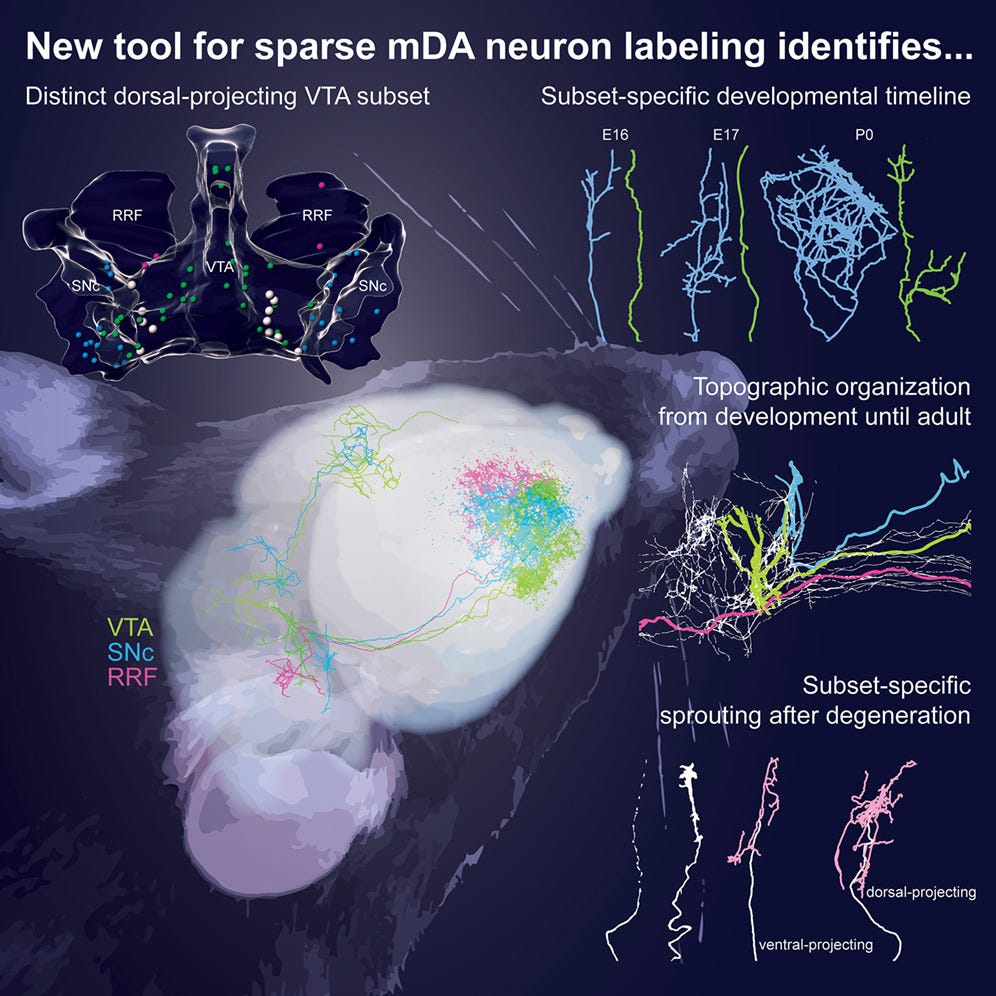
Using a novel intersectional genetic strategy for sparse neuronal labeling, researchers reconstructed individual midbrain dopamine neurons throughout development, adulthood, and degeneration. The resulting atlas reveals previously unrecognized morphological diversity, developmental wiring principles, and subtype-specific connectivity. For SPIN, this single-neuron resource provides an anatomical framework for testing how activity-dependent synaptic maintenance is preserved or lost with age across identified dopaminergic circuits.
Buy Me a Coffee makes it easy to publish free and exclusive content.
Biology · Neuroscience No. 2
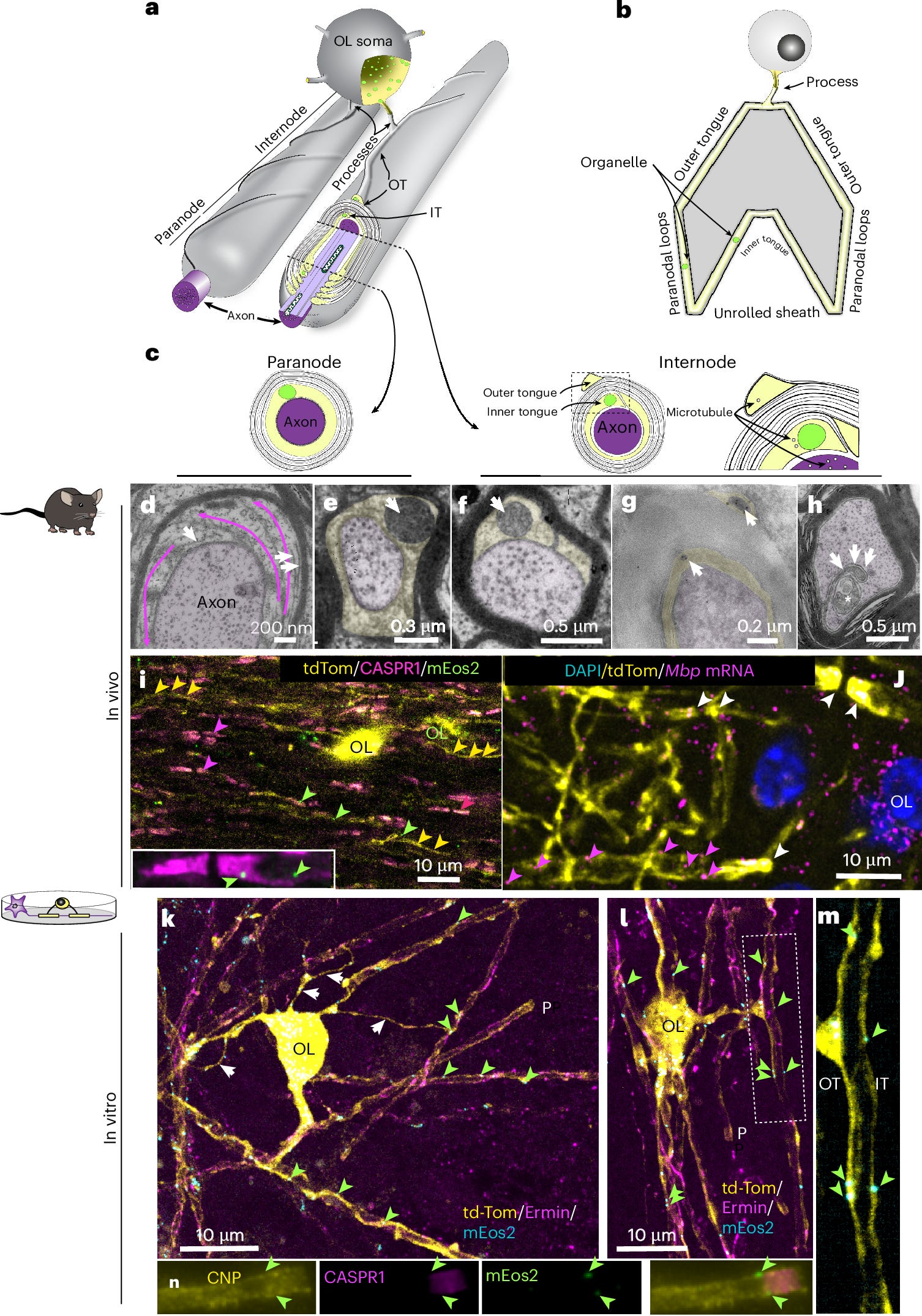
An activity-modulated transport route across myelin (TRAM) for motor-driven organelle transfer in oligodendrocytes
Oligodendrocytes use a newly identified transport pathway, named TRAM, to move organelles through their processes in an activity-dependent manner. The findings show that motor-driven organelle transfer along this route addresses a logistical challenge at the interface between process-bearing oligodendrocytes and the axons they myelinate. TRAM adds a cellular process that SPIN can incorporate when explaining how activity-dependent support for myelinated axons is maintained, and why these transport mechanisms may degrade with age.
Neuroscience · Computational Neuroscience No. 3
Unsupervised Feature Selection Using Bayesian Tucker Decomposition
Bayesian Tucker decomposition (BTuD) is introduced as an unsupervised feature-selection framework that explicitly models residuals during tensor decomposition. Applied to synthetic datasets, global coupled maps with randomized coupling strength, and gene expression profiles, the method identified informative features without labels and is expected to align with earlier tensor-decomposition-based feature extraction. For SPIN research, this provides a principled way to isolate low-dimensional structure from high-dimensional neural and expression data, supporting hypothesis-free searches for the sparse coding signatures that sleep-dependent maintenance may leave in network activity.
Neuroscience · Computational Neuroscience No. 4
Testing quantum-like markers in neural dynamics
The authors propose two falsifiable experiments to detect quantum-like features in neural data by testing quantum variants of standard models of neural activity. One experiment compares subthreshold oscillation spectra in neuronal cultures with the FitzHugh–Nagumo equations and a quantum variant; the other contrasts axonal propagation statistics with the classical diffusive cable equation and its quantum counterpart. If confirmed, such markers would help define the physical substrate of neural computation, with implications for how SPIN’s network-maintenance mechanisms operate in plastic circuits.
Biology · Molecular Biology No. 5
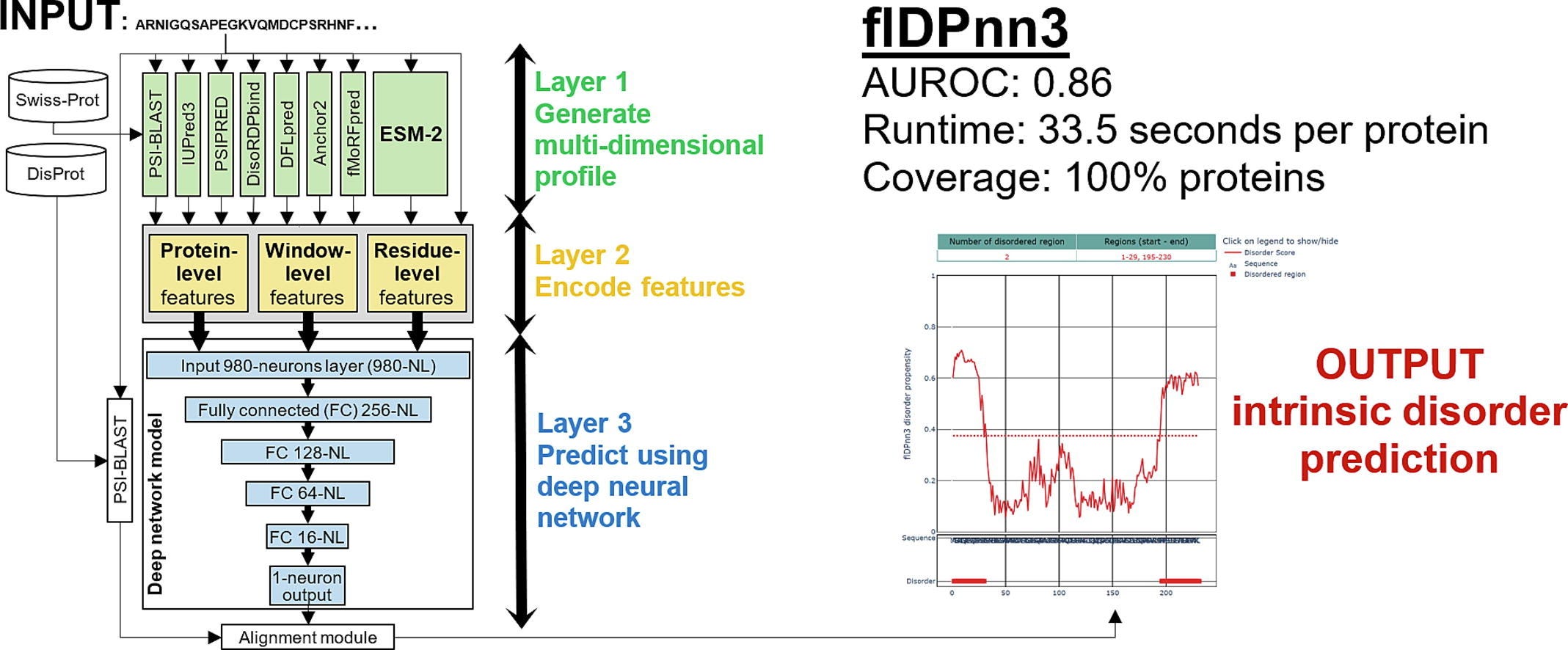
flDPnn3: Fast and Accurate Prediction of Intrinsic Disorder in Protein Sequences
flDPnn3 is a fast, high-accuracy predictor of intrinsic disorder in protein sequences, designed for rapid screening of disorder-prone regions. The method advances sequence-based disorder prediction, allowing large-scale annotation of proteins whose function depends on intrinsically disordered regions. For researchers studying aging and synaptic integrity, this provides a scalable computational tool for identifying protein regions that may be relevant to the molecular pathways underlying SPIN’s predicted maintenance failures.